Plan forward, not just around
The D&D campaign planner guide: apps, templates, and a free printable PDF.
Last reviewed: July 2026. We update this guide when the tools change, and we say when we did.
Some DMs plan on paper, some in an app, most in both. This guide covers the whole field: what a campaign planner actually needs to hold, a free one-page printable, the best template routes, and how Grimoire, the campaign manager for TTRPG GMs, handles the forward-planning half.
What is a D&D campaign planner?
A D&D campaign planner is any tool, digital or paper, that holds a campaign's moving parts (NPCs, factions, locations, plot threads, session plans) and helps a DM decide what happens next. A planner looks forward to the next session. A tracker records what already exists. Most DMs end up wanting both in one place.
The cost of not having one shows up around month three, when a player asks what the thieves' guild actually wanted from the ransom and you spend the scene flipping through three notebooks going "wait, who was that guy again?" A planner exists so the answer is where you left it, and so the next session starts from a decision instead of a search.
Planner, tracker, journal: three jobs, not three tools
A planner decides what is next: session prep, open threads, the arc you are steering toward. A tracker holds what exists: every NPC, faction, location, and item, with the fields that make them searchable. The D&D campaign tracker page covers that half in depth.
A journal records what happened: recaps, canon, the promises your party has already broken. The campaign journal page covers that one.
Three jobs, and in Grimoire they are one system: the plan reads the tracker, the journal feeds the plan. That loop is the point of the rest of this guide.
The paper half
A free printable D&D campaign planner (PDF, no email required)
Two pages, US Letter, prints fine on A4. No email. No watermark. Print it and go.
Page one is the campaign at a glance: your cast with wants and secrets, factions with goals, places, and six open threads with stakes and age. Page two is next session: an opening beat, likely scenes, clues to seed, cliffhanger options, and a post-session log. It is a D&D campaign planner PDF you can run a whole campaign on, and a printable campaign planner you can hand to a new DM without explaining anything.
Download the free planner PDF ↓Two pages, ~100 KB, yours. No email, ever.
An honest word before the app half of this guide: paper at the table is genuinely better for some DMs. No battery, no tab-switching, no temptation to read ahead. If your whole campaign fits a notebook, a notebook is a fine planner, and the hardcover campaign journals on Etsy and Amazon are good products. The pitch for an app is what happens in month six, not week one.
One more thing about this printable: its sections are Grimoire's schema on paper. A DM who fills it in has, without knowing it, drafted their first fourteen entities and their first session recap. If this sheet ever runs out of rows, that is the app.
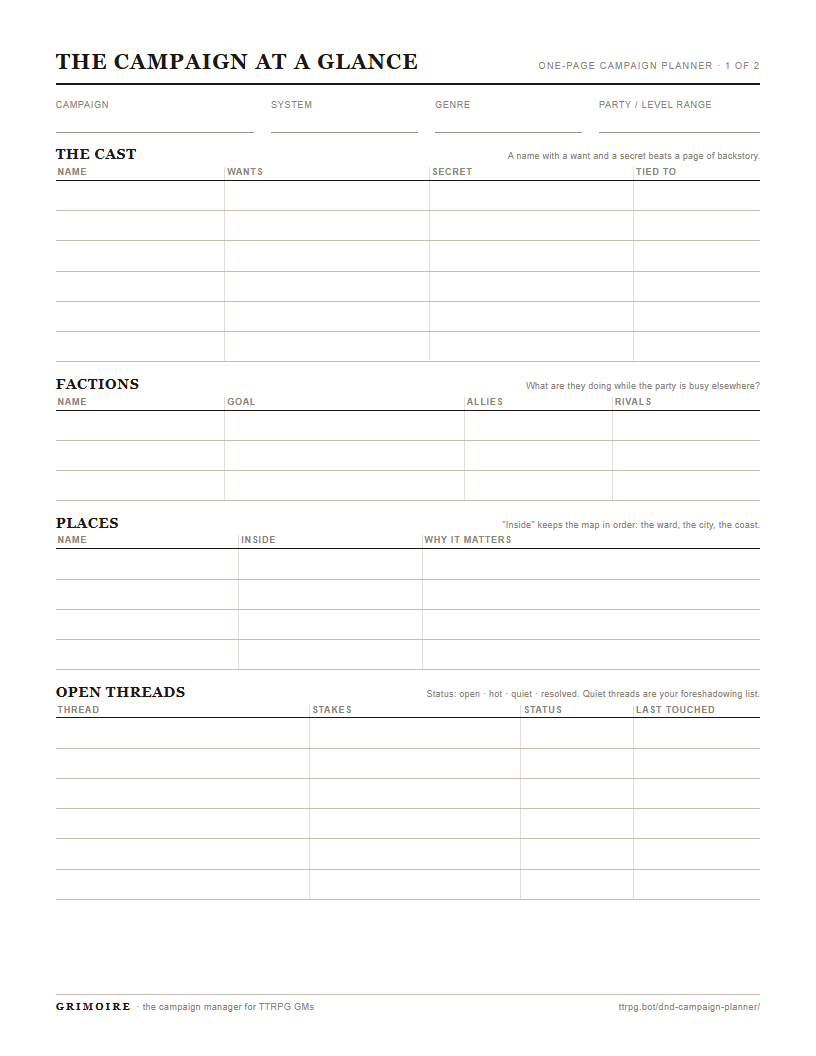 Page 1 of 2
 The checklist
What a good D&D campaign planner includes
Whatever the format, a planner that works holds six things. The printable above, the template routes below, and Grimoire itself all teach the same model, on purpose.
The cast
NPCs with wants and secrets, because a name without a motive is set dressing.
The powers
Factions and the moves they are making while the party is busy elsewhere.
The map
Locations that nest, so "where is this" always has an answer one level up.
The threads
Open plots with stakes and age, visible until you resolve them.
The next session
A plan you can actually run from: opening beat, likely scenes, clues, cliffhangers.
The record
What actually happened, so next week's plan starts from what is true.
The honest comparison
Paper, templates, or an app: how the three approaches compare
Three ways DMs actually plan campaigns, compared on the rows that decide it. Each column wins somewhere, and the somewhere is the point.
| Paper: notebook or printable PDF | DIY template: Notion or Obsidian | Campaign planner app (Grimoire) | |
|---|---|---|---|
| Setup before first session | None. Print and write. | 8-15 hours to build or adapt a schema | Minutes. The schema ships built. |
| At the table | Best in class. No battery, no tabs. | Good, needs a device | Good, needs a device |
| Search and filters | You, re-reading | Solid text search; filters if you built them | Typed filters ("open quests touching this faction") |
| Connections between things | Drawn by hand, goes stale | Backlinks; graphs need plugins and assembly | Knowledge graphs generated from the records |
| Player sharing and secrets | Photocopies | Manual publish or share per page | Player portal with three visibility tiers, GM Secrets stay server-side |
| Month six of the campaign | Notebook #3, cross-references by memory | Works if you maintain the system | The system maintains itself as records accrue |
| Cost | The PDF above is free; notebooks $10-30 | Free tiers cover it; your time is the cost | Free tier: 1 campaign, up to 100 entities, no ads |
Comparison reflects each approach as of July 2026; template estimates match the setup-time ranges reported in community guides. We build Grimoire, and the paper column still wins the at-table row.
The DIY half
Free D&D campaign planner templates (Notion, Obsidian, and print)
Templates are the middle road: free software, real structure, and your evenings as the construction budget. All three routes below genuinely work; they differ in what they cost you later.
Notion templates
A real option. The free tier is enough for a full campaign, the community templates are plentiful, and linked databases can model NPCs, factions, and quests credibly. Budget 8 to 15 hours to build or adapt a schema before your first session, and expect to be the one maintaining it forever. The honest limits, and where Notion campaign setups strain, are documented in our comparison.
An Obsidian campaign planner
Free, local-first, markdown you own outright, with a plugin ecosystem that can build a genuinely deep campaign vault. The start is steeper: folder structure, templates, and the plugins themselves are all decisions you make before the fun part. If you enjoy building systems as much as running them, it is a fine home. We wrote up Obsidian for campaign planning honestly, including the parts it does better than we do.
Printable and paid PDFs
Etsy and DriveThruRPG carry good paid planners, from single-sheet session pages to hardcover campaign journals, and quality varies more than price does. The one above is free, covers both the campaign view and the session view, and does not ask for your email on the way out.
Grimoire ships the template you would have built: fourteen typed categories with the fields already there. Stop rebuilding the same NPC template for the fourth time.
The app half
How forward planning works in Grimoire
The campaign tracker page tours the database. This is the other half: the parts of Grimoire that exist purely to answer "what happens next Saturday."
Session prep that stays GM-only
Session Prep is a first-class record type with no player-facing route at all, the one deliberate exception to the sharing system. Plan the ambush in the same system that knows who is being ambushed, note which secrets are load-bearing, and none of it can leak into the player portal, because there is no door for it to leak through.
Open threads that age
Plot threads are records with stakes and status, not lines in an old note. The dashboard shows which threads have gone quiet, so the ransom nobody answered for five sessions raises its hand on its own. Foreshadowing stops being a memory exercise and becomes a list you check.
Plans built from state
"Every open quest touching the thieves' guild" is a filter, not an evening of re-reading. Next session's plan starts from what is true now: current threads, fresh canon, and the connections the campaign knowledge graph surfaces between them, which is where half of good prep ideas actually come from.
When a plan touches things players should eventually see, every record carries a visibility tier (Common Knowledge, Player Knowledge, or GM Secret) that decides what the player portal shows, automatically.
One optional extra: if you already use an AI assistant for prep, Grimoire's plans and canon are readable by it over MCP, live. Entirely optional, off by default in spirit: the planner works fully without it. See Grimoire MCP.
The method
How to plan a D&D campaign (without over-preparing)
Six steps, tool-agnostic on purpose: every one of them works on the printable above just as well as in an app. Starting from a truly blank world instead? That is building a D&D campaign from scratch, and it has its own guide.
-
Fix the frame
System, genre, tone, party. Write it once, in one place, so every later decision has something to check against. In Grimoire this is the Campaign Bible and World Foundations; on the printable it is the header row.
-
Seed the cast and the map
A dozen NPCs with wants, three factions with goals, five locations that nest inside each other. Typed beats prose: a name with a want and a secret is worth a page of backstory you will never re-read.
-
Write threads, not plots
Open questions with stakes, not scripts with scenes. "Who is paying the ransom, and what happens if nobody does?" survives contact with players. A three-act outline does not.
-
Plan one session deep
An opening beat, the likely scenes, the clues you want seeded, and two cliffhanger options. That is a full prep. Anything further ahead is a bet the table has not agreed to yet.
-
Play, then record
A short recap after the session: what happened, what became canon, what the players now know. Five minutes while the pizza boxes are still on the table beats an hour of archaeology on Thursday.
-
Re-plan from the record
Next week's prep starts from open threads and fresh canon, not from re-reading. The question is never "what did I write" but "what is open," and a good planner answers it in one look.
Plan
Session Prep
Play
The table
Record
Session Recap
Re-plan
Open Threads + canon
A planner is the loop, not a page.
FAQ
Campaign planner questions, answered
What is a D&D campaign planner?
A D&D campaign planner is whatever holds the moving parts of your game and points them at the next session: the cast, the factions, the places, the open threads, and the plan you run from. It can be digital or paper. The format matters less than the job, which is deciding what happens next without re-reading everything you have ever written.
What is the difference between a campaign planner and a campaign tracker?
A planner points forward: session prep, open threads, what happens next. A tracker records state: who exists, what changed hands, what is true right now. Grimoire does both in one system; this guide covers the planning half, and the campaign tracker page covers the database half.
Is there a free D&D campaign planner?
Yes, three honest routes: the free printable PDF on this page (no email required), a Notion or Obsidian template if you enjoy building systems, and Grimoire's free tier (1 campaign, up to 100 entities, graphs, wiki, player portal, no ads).
Where can I get a D&D campaign planner PDF?
The one on this page is free and ungated: two pages, a campaign overview plus a next-session sheet, US Letter, prints on A4. Etsy and DriveThruRPG sell richer paid planners and quality varies; hardcover campaign journals are a good gift-shelf option.
Should I plan my campaign on paper or in an app?
Most long-running DMs land on both: an app between sessions because it searches and connects, paper at the table because it never runs out of battery. Start with whichever removes friction this week.
How far ahead should I plan a D&D campaign?
One session deep, one arc wide. Write threads with stakes instead of plots with scripts, then let play decide which threads advance. Over-planning is the most common way prep time gets wasted.
Does this work for systems other than D&D?
Yes. The printable is system-agnostic, and Grimoire's genre engine reshapes the schema for Fantasy, Sci-Fi, Horror, Post-Apocalyptic, Modern, Superhero, or Historical campaigns.
Plan next Saturday in an evening.
The free printable if you want paper. The full system if you want the campaign to plan itself forward: fourteen typed categories, open threads, session prep, and a player portal. Free tier, no credit card.
New here? The fifteen-minute quickstart goes from signup to a queryable world.